
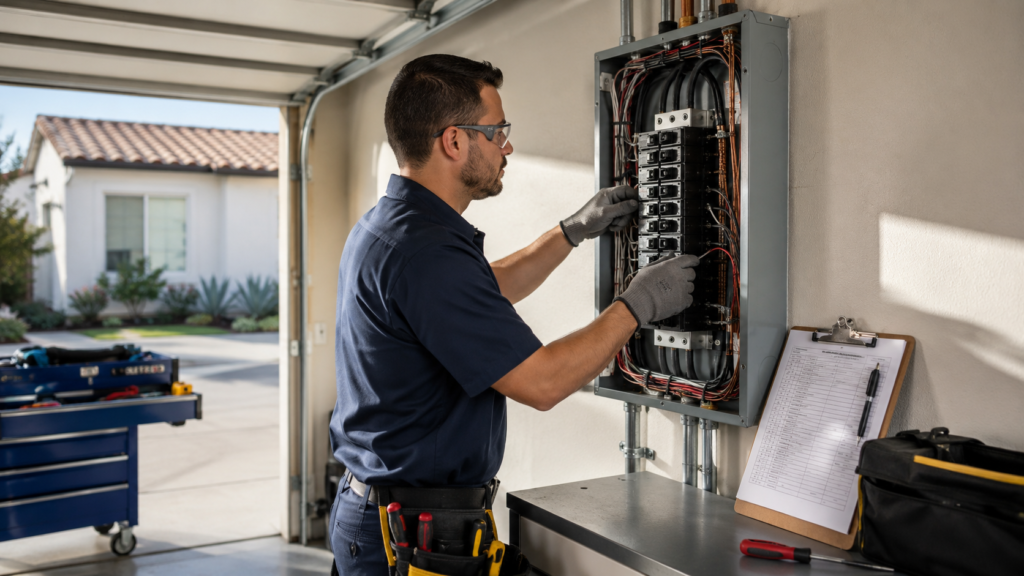
If you’ve been searching for a straight answer on electrical panel upgrade pricing, you’ve probably noticed something frustrating: every site gives you a different number, and almost none of them account for where you actually live. Southern California permitting fees, utility coordination, and labor rates vary a lot between, say, Lancaster and Santa Clarita – and that affects your final bill more than most homeowners expect.
This guide breaks down real 2026 pricing for electrical panel upgrades across Southern California, what drives the cost up or down, and how to know if you actually need one.
Why Panel Upgrades Are Suddenly a Hot Topic
Electrical panel upgrades used to be a niche concern, mostly for older homes with outdated fuse boxes. That’s changed. Three trends are pushing more Southern California homeowners to upgrade their panels right now:
- EV adoption. A Level 2 EV charger draws far more continuous current than most household circuits were designed for. Many 100-amp panels simply don’t have room left for a dedicated charger circuit.
- Home electrification. Heat pumps, induction ranges, and electric water heaters all add load to a system that was likely sized decades ago.
- Aging housing stock. A large share of homes in the Antelope Valley and the Santa Clarita Valley still run on 60-amp or 100-amp panels installed when central air and electric everything weren’t the norm.
If any of that sounds like your situation, the question isn’t really “do I need this,” it’s “what will it cost me.”
What Determines Your Panel Upgrade Cost
There’s no single flat-rate answer, but the price is driven by a fairly predictable set of factors:
1. Panel amperage (the size you’re upgrading to) Most older homes have 60-amp or 100-amp service. Upgrading to 200-amp service is the most common jump today, since it comfortably supports an EV charger plus modern appliances. Going to 200-amp from 100-amp typically costs more than going from 100-amp to 150-amp, simply because of the heavier wiring and breaker hardware involved.
2. Whether the utility service line needs upgrading too Sometimes the panel itself isn’t the bottleneck — the service line coming from the street is. If your utility (SCE in most of the areas we serve) needs to upgrade the drop or meter, that adds both cost and lead time, since it requires utility scheduling, not just electrician availability.
3. Permit and inspection fees Permit costs vary by city and county. Los Angeles County, the City of Santa Clarita, and Antelope Valley jurisdictions all have different fee schedules and inspection timelines. This is one of the most overlooked cost variables — it’s not labor, but it’s not optional either.
4. Panel location and accessibility A panel that’s easy to access on an exterior wall is a much simpler job than one buried in a finished garage wall or relocated entirely. Relocation work (moving a panel to a new wall or area of the house) adds meaningfully to labor time.
5. Age and condition of existing wiring If your home still has older wiring types or ungrounded circuits, an electrician may recommend addressing some of that during the panel work rather than as a separate visit later. This isn’t always required, but it’s worth budgeting flexibility for.
Typical Cost Ranges in Southern California (2026)
While every home is different, here’s a general sense of where pricing lands across the region right now:
- 100-amp to 150-amp upgrade: Lower end of the range – straightforward jobs with no service line changes
- 100-amp to 200-amp upgrade: The most common upgrade for EV-charger-ready homes – mid-range pricing
- 60-amp to 200-amp upgrade (older homes): Higher end, due to more extensive rewiring and code-compliance work
- Panel relocation or service line upgrade involved: Add a meaningful premium on top of any of the above
The honest answer is that getting an exact number requires a home visit — panel age, wiring condition, and access all shift the estimate. But if a quote comes in dramatically lower than what a same-size job should cost, it’s worth asking what’s being left out (permits, inspection, cleanup, code corrections).
Signs You Probably Need a Panel Upgrade
You don’t need to guess. A few common signals:
- Breakers trip regularly, especially when running multiple large appliances
- Your panel is still rated for 60 or 100 amps and you’re planning to add an EV charger
- You see visible rust, scorch marks, or an outdated fuse-style panel
- A home inspection flagged the panel as a safety or capacity concern
- You’re adding a major appliance (induction range, heat pump, hot tub) and your electrician says the existing panel can’t support it
If you’re specifically planning ahead for EV charging, it’s worth reading our breakdown on panel upgrades for EV chargers, since the sizing requirements for charger-ready panels are a little different from a general capacity upgrade.
How Panel Upgrades Connect to EV Charger Installation
This is the part a lot of homeowners miss: if you’re getting an EV charger installed and your panel is undersized, the panel upgrade and the charger installation often need to happen as a coordinated project, not two separate ones. Trying to add a charger circuit to a panel that’s already at capacity is how you end up with tripped breakers or a failed inspection.
If you’re in this position, it’s worth looking at our Level 2 EV charger installation guide alongside your panel upgrade planning, so both pieces get scoped together from the start.
Local Pricing Considerations by Area
Because permitting and average home age vary by city, here’s a quick look at a few of the areas we work in most:
- Santa Clarita homeowners dealing with older panels can check our Santa Clarita EV charger installation page for how panel capacity factors into local installs.
- Lancaster residents — where panel upgrade searches are especially common — can see related service details on our Lancaster EV charger installation page.
- Palmdale homeowners planning ahead for EV charging should check the Palmdale EV charger installation page for what panel capacity is typically needed.
- Valencia residents can find more on local install considerations through our Valencia EV charger installation page.
- Stevenson Ranch homeowners can see how we’ve approached panel and charger coordination on the Stevenson Ranch EV charger installation page.
Getting an Accurate Quote
Because so many variables affect the final number — amperage jump, permit jurisdiction, service line condition, panel accessibility the only way to get a number you can actually rely on is an in-home assessment. A phone quote without seeing your panel is, at best, a rough guess.
When you do get quotes, make sure each one clearly states:
- Target amperage (100A, 150A, 200A)
- Whether permit and inspection fees are included
- Whether utility coordination is needed
- Whether any existing wiring will be addressed as part of the job
- Estimated timeline, including permit turnaround
A vague one-line quote with just a dollar amount is a red flag it usually means something gets added later as a “surprise.”
The Bottom Line
Panel upgrade costs in Southern California in 2026 depend heavily on your starting amperage, your city’s permitting process, and whether utility-side work is involved. If you’re upgrading specifically to support an EV charger, it’s worth scoping the panel work and the charger installation together rather than as separate projects it saves both time and money in most cases.
If you’re ready to get a real number for your home, reach out through our contact page and we’ll walk you through what your specific upgrade would involve, area by area, panel by panel.
Leave a Reply