
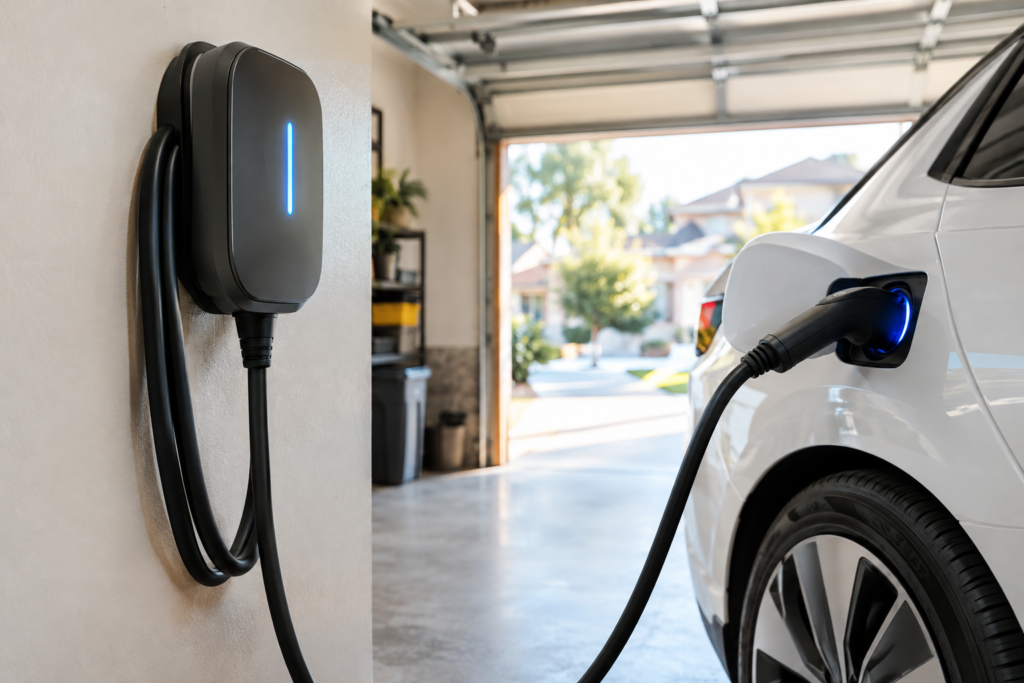
If your home or business EV charger suddenly stops cooperating, you’re not alone. Most charging problems fall into a short list of common culprits – and while a few can be fixed in minutes, others are signs of a deeper electrical issue that needs a professional. Below is a complete troubleshooting checklist covering the 15 issues we see most often, plus when it’s time to call an electrician instead of digging out the toolbox.
1. Charger Won’t Turn On or Has No Power
Start with the basics: check the breaker panel for a tripped breaker, confirm the unit is plugged in (for plug-in chargers), and look for a status light on the charger itself. If the unit shows no signs of life at all, the issue is often upstream in the electrical panel rather than the charger – something a panel upgrade may be masking if your panel is older or undersized.
2. Charging Cable Won’t Connect or Latch
A cable that won’t lock into the vehicle’s charging port is usually caused by debris in the port, a worn latch mechanism, or the vehicle not being fully “awake.” Clean the port with a dry cloth, make sure the car is unlocked, and try again. If the latch mechanism itself feels loose or damaged, it needs replacement rather than repair.
3. Charging Stops Mid-Session
Charging that starts fine but cuts off partway through is often thermal protection kicking in, a loose wiring connection, or a scheduled charging setting in the vehicle’s app overriding the session. Check your EV’s charging schedule settings first – this fixes the issue more often than people expect.
4. Slow Charging Speeds
If your Level 2 charger is delivering power far below its rated speed, the cause is usually one of three things: the charger is set to a lower amperage in its configuration, the circuit is shared with another high-draw appliance, or the vehicle itself is limiting the charge rate due to battery temperature. Our team handles smart charger configuration adjustments regularly for exactly this issue.
5. Tripped Breaker or Circuit Overload
A breaker that trips every time you plug in usually means the circuit is undersized for the charger’s draw, or another appliance is sharing the same circuit. This is not a DIY fix – a breaker that keeps tripping is a safety signal, not an inconvenience to work around.
6. GFCI Nuisance Tripping
Ground Fault Circuit Interrupter trips are common with outdoor or garage installations exposed to moisture. Occasional trips after rain are normal; frequent trips in dry conditions point to a wiring fault or a failing GFCI breaker that needs replacement.
7. Error Codes or Blinking Status Lights
Most charger manufacturers use blinking light patterns or numeric error codes to indicate specific faults – from voltage irregularities to internal component failures. Check your charger’s manual for the specific code, but a solid red or rapidly flashing light generally means the session should not be attempted again until inspected.
8. Wi-Fi or Smart App Connectivity Problems
Smart chargers that lose their app connection are almost never an electrical issue – it’s typically a router, firmware, or account sync problem. Restarting the charger and your router, then re-pairing the app, resolves the majority of these cases.
9. Charger Overheating
Warm-to-the-touch is normal during charging; hot enough to trigger a thermal shutdown is not. Overheating is frequently linked to an undersized circuit working harder than it should, poor ventilation around the unit, or a loose electrical connection generating resistance heat. This is one of the more serious issues on this list and warrants a professional safety inspection.
10. Charging Cable Damage or Wear
Cracks, exposed wiring, or a stiff, brittle cable jacket are safety hazards, not cosmetic issues. Never attempt to tape or patch a damaged charging cable – it needs professional replacement.
11. Vehicle Not Recognizing the Charger
If your EV doesn’t register that it’s plugged in, first rule out a software glitch by restarting the vehicle’s infotainment system. If the issue persists across multiple vehicles or app resets don’t help, the communication pins inside the connector may be worn or misaligned.
12. Inconsistent Charging (Start-Stop-Start)
A charging session that repeatedly starts and stops rather than running continuously usually indicates a loose connection somewhere in the circuit – at the breaker, the charger’s wiring terminals, or the outlet if you’re using a plug-in unit. Loose connections generate heat and are a fire risk, so this should be inspected promptly.
13. Outdated Firmware
Many charging faults that look like hardware failures are actually solved by a firmware update. Check your charger app or manufacturer’s site for available updates before assuming the unit itself has failed.
14. Weather-Related Malfunctions
Outdoor chargers exposed to extreme heat, cold, or heavy rain can temporarily derate their charging speed or pause sessions as a protective measure. This is expected behavior for most units, but chargers that fail permanently after a single weather event may have inadequate weatherproofing for their installation location.
15. Panel Can’t Support the Charger’s Load
This is the root cause behind a surprising number of “charger” problems that aren’t actually about the charger at all. Homes with older 100-amp panels, or panels already running close to capacity with other appliances, often can’t reliably support a Level 2 charger’s continuous draw – leading to nuisance trips, slow charging, or intermittent shutdowns. If you’re facing recurring electrical issues alongside your charging problems, it’s worth reviewing 100-amp vs. 200-amp panel options before replacing hardware that may not be the actual problem.
When to Call a Professional
A good rule of thumb: anything involving your breaker panel, repeated tripping, overheating, or exposed wiring is not a DIY project. EV chargers run on dedicated high-amperage circuits, and troubleshooting them incorrectly risks both your safety and your equipment warranty.
If you’ve worked through this list and your charger still isn’t behaving, our team offers dedicated EV charger troubleshooting and repair services across Southern California, along with emergency charger repair for urgent issues and ongoing charger maintenance plans to catch problems before they leave you stranded without a charge.
Not sure whether your issue is a quick fix or something bigger? Contact us and we’ll help you figure out the fastest path back to reliable charging.
Leave a Reply