
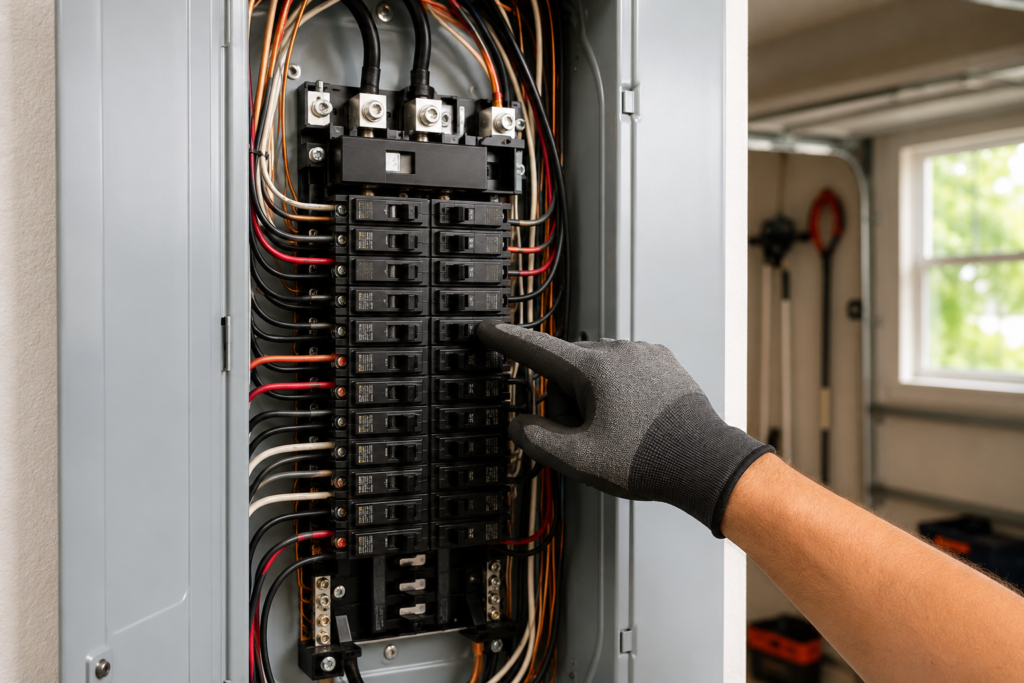
If your lights flicker when the AC kicks on, your breaker trips every time you run the microwave and a hair dryer at once, or you’re planning to add an EV charger installation, there’s a good chance the answer starts with your electrical panel. The two most common upgrade paths homeowners in Southern California face are moving from a 100 amp panel to 200 amps – or, in some cases, going even higher for larger homes and EV-heavy households.
This guide breaks down what each size actually supports, what the electrical panel upgrade cost looks like for both options, and how to figure out which one is right for your home.
What Does Panel “Amperage” Actually Mean?
Your electrical panel is the hub that distributes power from the utility line to every circuit in your house. The amperage rating – 100A, 150A, 200A, or higher – tells you the maximum amount of electrical current the panel can safely handle at once. Think of it like the diameter of a pipe: a bigger number means more capacity flowing through your home at the same time, with less risk of overload.
Older homes built before the 1990s were commonly wired with 100 amp service, which was sufficient for the appliance load of that era. Today’s homes run central air conditioning, electric ranges, hot tubs, home theaters, multiple computers, smart home devices, and increasingly, electric vehicles – all of which draw far more power than homes were originally designed for.
100 Amp Panels: What They Can (and Can’t) Handle
A 100 amp panel can comfortably run a small to mid-sized home with standard appliances: refrigerator, washer/dryer, central AC, and general lighting and outlets. Where 100A panels start to struggle is when you add high-draw equipment on top of that baseline – a hot tub, an electric range and oven, a workshop, or a Level 2 EV charger.
Many of the highest-volume questions we see – things like “electrical panel upgrade near me” and “cost to install a new electrical panel” – come from homeowners who hit this exact wall: they’re not having a problem yet, but they know their next big purchase (usually an EV or a home addition) won’t work on their current setup.
Signs your 100A panel is maxed out:
- Breakers trip when running two or more large appliances simultaneously
- Your electrician tells you there’s no room to add a new circuit
- You’re getting quotes for an EV charger and being told a panel upgrade is required first
- Your panel is a Zinsco, Federal Pacific, or other older brand no longer considered safe by current code standards
- You’re adding square footage, a pool, or a workshop
200 Amp Panels: The New Standard
200 amps has become the standard recommendation for most single-family homes being upgraded today, and for good reason. It gives you enough headroom to run all standard household appliances plus room to grow – a Level 2 EV charger, a pool pump, a home addition, or a future kitchen remodel — without needing another upgrade five years later.
If you’re comparing a Level 2 vs Level 1 EV charger for your home, it’s worth knowing that Level 2 chargers typically draw 30-50 amps continuously. On a 100A panel that’s already running close to capacity, that load alone can push you over the edge. A 200A panel absorbs it easily.
For larger homes (3,500+ sq ft), homes with multiple EVs, or properties considering solar plus battery storage, some electricians recommend going even higher – 225A or 400A service – though 200A covers the vast majority of residential cases.
Cost Comparison: 100A vs 200A Panel Upgrade
Panel upgrade pricing depends on your home’s existing wiring, whether the service line from the utility also needs upgrading, permit fees in your city, and panel brand/quality. That said, here’s a general range homeowners in Southern California can expect:
| Upgrade Type | Typical Cost Range | Best For |
|---|---|---|
| 100A to 150A | Less common; similar labor cost to 200A upgrade | Rarely recommended – minimal savings vs 200A |
| 100A to 200A | Mid-range of most panel upgrade quotes | Most single-family homes, EV charger prep, remodels |
| 200A to 400A (or dual 200A) | Highest end of the range | Large homes, multiple EVs, solar + battery, workshops |
Because “150A” service isn’t significantly cheaper than 200A once an electrician is already replacing the panel, meter, and connections, most licensed electricians will simply recommend jumping straight to 200A – it costs a similar amount in labor but future-proofs the home for years longer. This holds true whether you’re located in Santa Clarita, Lancaster, or elsewhere across our Southern California service area – local permit fees vary, but the labor-to-value math stays consistent.
For a full breakdown of what drives these numbers – permit fees, utility coordination, panel brand, and labor – see our complete electrical panel upgrade pricing guide.
If you’re planning to add an EV charger, a panel upgrade often comes first, so take a look at our EV charger installation services to see how the two fit together. Not sure if your home needs more than a 100 amp to 200 amp upgrade? Our electrical panel upgrade page explains what’s involved, and you can learn more about electrical services from Electra Work to see everything we offer for Southern California homes.
What Actually Drives the Cost Difference
A handful of factors explain most of the price variation between quotes, regardless of whether you’re going to 100A, 200A, or higher:
1. Service line and meter:- If your utility drop and meter base also need upgrading to handle higher amperage, that adds cost beyond just swapping the panel box itself.
2. Utility coordination:- In Southern California, most upgrades require coordination with Southern California Edison or your local utility to disconnect and reconnect service safely – this can add scheduling time and inspection fees.
3. Permits and inspection:- Every panel upgrade requires a permit and inspection through your city or county. Our team handles this as part of permit acquisition assistance so you’re not navigating city requirements alone.
4. Panel brand and breaker count:- A 200A panel with 40+ breaker slots (useful if you’re planning future circuits for EV charging or a workshop) costs more than a bare-minimum 20-slot panel.
5. Rewiring needs:- Homes with older knob-and-tube or aluminum wiring sometimes need additional work beyond the panel itself to meet current code.
How This Connects to EV Charger Installation
If an EV charger is part of what’s motivating the upgrade, it’s worth planning both at once rather than doing them as separate projects. A combined panel upgrade for EV chargers means one permit process, one inspection, and one disruption to your home instead of two – and it’s typically more cost-effective than upgrading the panel now and adding charger wiring later.
This is especially relevant if you’re in a multi-unit or shared property, where panel capacity needs to be planned across multiple future chargers, not just one.
So, Which One Do You Need?
As a general rule of thumb:
- Stick with 100A (no upgrade needed) if your home is small, you have no plans to add an EV charger, pool, or major appliances, and you’re not currently experiencing tripped breakers or capacity issues.
- Upgrade to 200A if you’re adding a Level 2 EV charger, planning a remodel or addition, replacing an aging or unsafe panel (Zinsco/FPE), or simply want headroom for the next 15-20 years of normal household growth. This covers the vast majority of homeowners who reach out to us.
- Consider 400A or dual-panel setups if you have a large home, multiple EVs, solar with battery storage, or a workshop/ADU with significant electrical demand.
The only way to know for sure is a load calculation from a licensed electrician, who can look at your actual appliance list, square footage, and future plans rather than guessing from general rules.
Frequently Asked Questions
How long does a panel upgrade take? Most residential panel upgrades take one to two days of on-site work, though the full process – including permitting and utility scheduling – often spans one to three weeks from start to finish. Older homes or those needing service line upgrades can take longer.
Will I lose power during the upgrade?
Yes, briefly. Your utility needs to disconnect service to safely swap the panel, so expect a planned power outage of a few hours on installation day. Your electrician will coordinate this in advance so it’s not a surprise.
Do I need a permit for a panel upgrade?
Almost always, yes. Panel upgrades involve your home’s main electrical service and require a permit and inspection in nearly every Southern California city. Skipping this step can create problems later when selling your home or filing an insurance claim.
Can I upgrade to 200A without adding an EV charger right now?
Absolutely, and it’s often the smarter move. Upgrading capacity now – even if you’re not installing a charger this year – means you avoid a second disruption and a second permit process later. Many homeowners upgrade proactively before buying an EV.
Is a 200A panel enough for solar panels too? In most cases, yes, though it depends on your system size and whether you’re adding battery storage. A licensed electrician can confirm during your load calculation.
Get a Straight Answer for Your Home
Every home’s situation is a little different, and the right panel size depends on more than just square footage. If you’re weighing a 100A vs 200A upgrade – especially with an EV charger installation on the horizon – contact us for a free assessment. We’ll walk your panel, calculate your actual load, and give you a clear, itemized quote before any work begins.
Leave a Reply