There’s nothing more frustrating than walking out to your garage expecting a full battery and finding your EV charger not working at all. Before you assume the worst, know this: most charging issues come down to a short list of common, fixable problems – from tripped breakers to loose connectors to outdated panels that simply can’t keep up with an EV’s power draw.
Below, we’ve put together basic troubleshooting tips for EV chargers that homeowners can try safely on their own, along with the warning signs that mean it’s time to call in a professional. If you’d rather skip straight to expert help, our team offers full EV charger troubleshooting and EV charger safety inspection services across Southern California.
1. The Charger Won’t Turn On at All
If your charger shows no lights and no response, start with the basics: check that it’s securely plugged into the outlet (for Level 1/portable units) or that the breaker hasn’t tripped. A dead charger is often simply a power supply issue, not a broken unit. If the outlet and breaker check out but the charger still won’t power on, the internal components may have failed and it’s time for a professional diagnostic.
2. Charging Stops Randomly Mid-Session
Charging sessions that stop and restart – or just quit halfway through – are usually caused by loose wiring connections, an overheating charger, or a car communication error. This is one of the most common complaints we hear, and it’s rarely something to fix by guesswork. Our charger maintenance service includes a full inspection of connections and load performance to catch this before it strands your car with an empty battery.
3. Charging Is Slower Than Usual
A charger that used to fill your battery overnight but now takes twice as long is often a sign of voltage drop, a damaged cable, or a panel that’s undersized for the load. This is especially common in older homes. If your home still runs on an older panel, a panel upgrade for your EV charger is frequently the real fix – not a new charger.
4. Blinking Lights or Error Codes
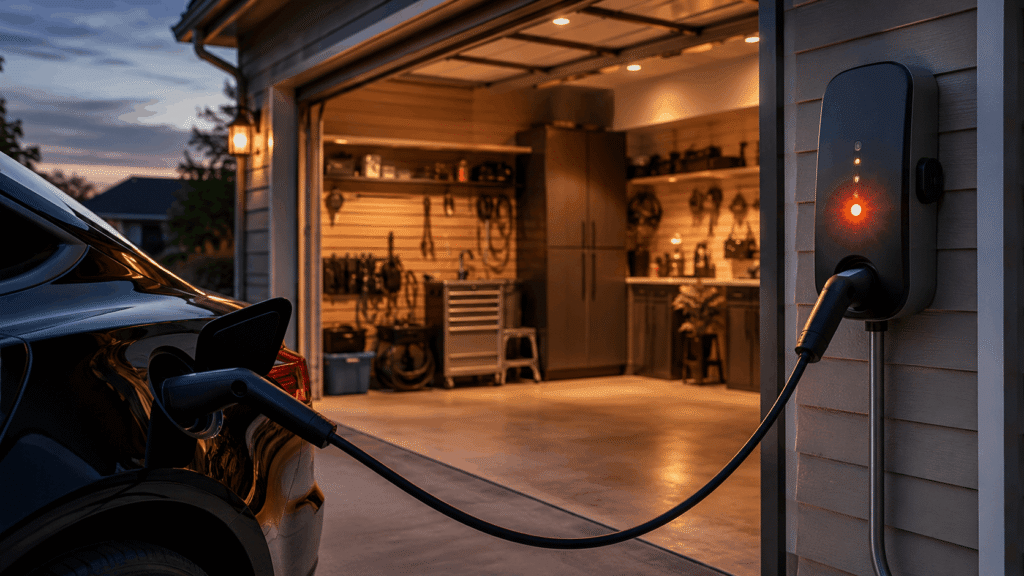
Most Level 2 chargers communicate status through LED colors or blink patterns. A solid green or blue light usually means “ready,” while red, amber, or rapid blinking usually signals a fault. Check your charger’s manual for the specific code, but don’t ignore repeated fault codes – they often point to a ground fault or overheating issue that needs a licensed electrician’s attention.
5. The Charger Keeps Tripping the Breaker
This is one of the clearest signs of an electrical panel upgrade need. EV chargers draw a continuous, heavy load, and older 100-amp panels – especially in homes built before EVs were common – often can’t handle it safely. If your breaker trips every time you plug in, don’t just reset it repeatedly. Read our full guide on 100 amp vs. 200 amp panel upgrades to understand what your home may need, or get a straight answer on electrical panel upgrade cost in Southern California.
6. Charger Won’t Connect to Wi-Fi or the App
Smart chargers rely on a stable home network connection for scheduling, monitoring, and remote start/stop. If yours won’t connect, try restarting your router and moving the charger closer to your Wi-Fi source before assuming it’s broken. Persistent connectivity issues can also stem from incorrect installation settings – something our smart charger configuration service resolves quickly.
7. Damaged or Stiff Charging Cable
Cold weather, UV exposure, and repeated coiling can all cause a charging cable to crack, stiffen, or fray at the connector. A damaged cable is a safety hazard, not just an inconvenience – never continue using a charger with exposed wiring. This is a straightforward repair for a licensed electrician and shouldn’t be attempted as a DIY fix.
8. Charger or Connector Feels Hot
Some warmth during charging is normal, but a connector or charger housing that’s hot to the touch is not. This usually points to a loose electrical connection, an undersized circuit, or a component nearing failure – all of which carry fire risk if ignored. Stop using the unit and schedule an EV charger safety inspection right away.
9. GFCI Fault or Ground Fault Errors
Ground Fault Circuit Interrupter (GFCI) protection is built into most EV chargers as a safety feature, and it will shut down charging the moment it detects a fault – even a minor one, like moisture in the connector. If your charger shows a persistent ground fault error, don’t bypass it. It’s protecting you from a genuine electrical hazard, and the underlying wiring issue needs to be diagnosed by a professional.
10. Charger Works, But the Car Won’t Charge
Sometimes the charger itself is functioning perfectly, but the car isn’t accepting a charge. This can be a vehicle-side software glitch, a scheduled charging setting on the car, or a compatibility issue after a firmware update on either the vehicle or the charger. Check your car’s charging settings first; if the issue persists across multiple charging sessions, it’s worth having both the vehicle and the charger evaluated together.
DIY vs. Calling a Professional
A few things are safe to check yourself: outlets, breakers, app connectivity, and basic cable condition. But anything involving your electrical panel, wiring, persistent fault codes, or heat should always go to a licensed electrician. EV chargers run on dedicated high-amperage circuits, and a wiring mistake isn’t just inconvenient – it’s a fire and shock risk.
If your charger keeps failing, our team handles everything from same-day emergency charger repair to full-system EV charger troubleshooting and long-term charger maintenance plans.
When the Real Fix Is a Panel Upgrade
If you’ve worked through this list and your charger still isn’t performing reliably, the root cause is often your home’s electrical capacity, not the charger itself. Many homes – especially in older neighborhoods – were never wired for the continuous load an EV charger demands. Learn more about how to know how long an EV charger installation actually takes once a panel upgrade is factored in, or explore our Level 2 EV charger installation options if you’re considering replacing your current setup entirely.
We also install and service multi-unit and shared charging systems – if you manage a property with several EVs charging at once, our multi-unit EV charger installation service is built for that exact scenario.
Get a Professional EV Charger Diagnosis Today
A malfunctioning EV charger is rarely worth guessing about. Small issues like a loose connection can turn into safety hazards, and the wrong DIY fix can void your charger’s warranty. Our licensed electricians serve homeowners throughout Southern California, including Santa Clarita, Lancaster, Sun Valley, and Fair Oaks Ranch, with fast diagnostics and honest repair-vs-replace recommendations.
Don’t let a broken charger slow down your routine. Contact our team today to schedule an inspection and get your EV charging reliably again.
Frequently Asked Questions
Why did my EV charger suddenly stop working after months of no problems?
Chargers that worked fine and then suddenly fail are often reacting to something that changed in the home – a new appliance sharing the same circuit, seasonal temperature swings, or gradual wear on a connection that finally gave out. It’s rarely coincidence, which is why a proper diagnostic looks at the whole circuit, not just the charger unit itself.
Is it safe to keep using my charger if it only fails occasionally?
Intermittent faults are actually a bigger warning sign than a charger that fails consistently, since they usually point to a loose connection or a wire that heats up and expands under load. We’d recommend having it inspected before it fails completely – or worse, overheats.
Can a software update fix most charger problems?
Software and firmware updates can resolve app connectivity and scheduling issues, but they won’t fix a tripped breaker, a damaged cable, or an undersized electrical panel. If you’ve already updated the firmware and the problem persists, the issue is almost certainly electrical rather than digital.
How much does it cost to fix a broken EV charger?
Costs vary widely depending on the cause – a loose connection or blown fuse is a minor repair, while a full panel upgrade to support the charger’s load is a larger investment. We always diagnose first and give homeowners a clear, upfront estimate before any work begins.
Should I upgrade my panel even if my charger technically still works?
If your charger works but you’ve noticed slow charging, occasional breaker trips, or your panel is original to an older home, upgrading now is usually cheaper than waiting for a full failure. It also protects the rest of your home’s electrical system from the added strain.
Leave a Reply