
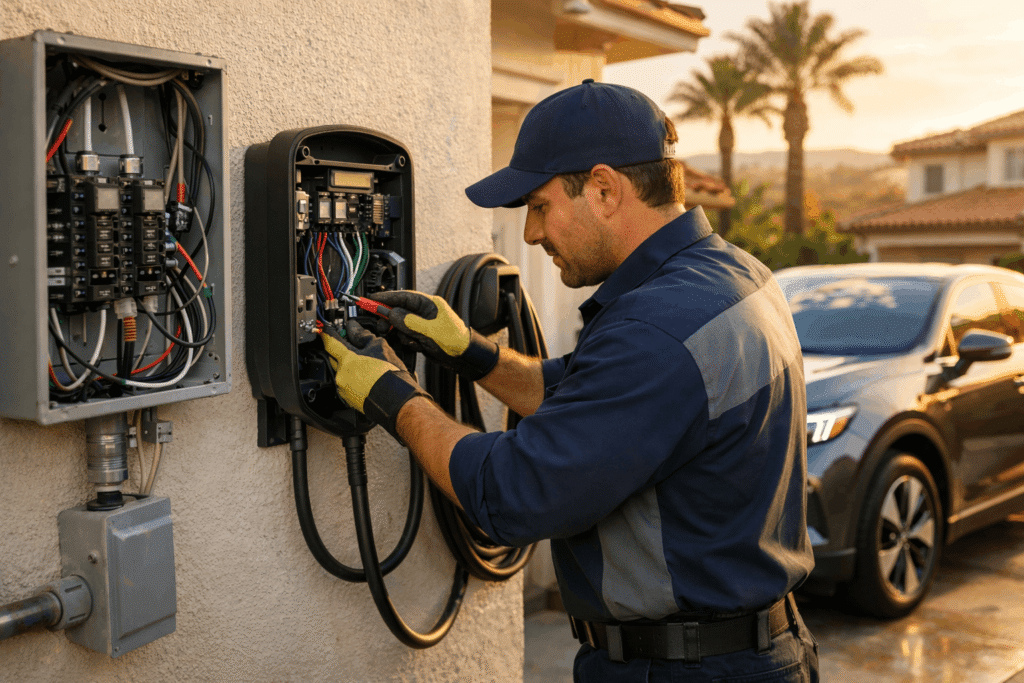
Southern California employers are asking the same question: how do we add EV charging at work without overloading the building’s electrical service or blowing the budget? Workplace EV charger installation has become a hiring perk, a sustainability goal and, for many businesses, a practical need as more employees and company vehicles go electric.
This guide covers what a workplace EV charging installation involves: costs, load management, incentives, permits and timelines. It is written for property managers, facility owners and business operators across LA County, the Santa Clarita Valley and the Antelope Valley.
Why Workplace EV Charging Is Worth the Investment
Employees who can’t charge at home, such as apartment and condo residents, rely on workplace charging. Offering it helps you:
- Attract and retain talent. Charging is now a visible perk, like parking or a gym.
- Support company vehicles. A few ports can cover sales cars, service vans or shared fleet vehicles.
- Meet sustainability targets. Charging on site supports ESG and clean-fleet goals.
- Add customer-facing value. Retail, medical and hospitality sites can open ports to visitors through public-access charger installation.
Most employers start with a small Level 2 deployment and expand as demand grows. Designing for that growth from day one is what keeps costs down later.
Level 2 vs. DC Fast Charging at Work
The right charger depends on how long vehicles sit in your lot.
Level 2 chargers (240V) suit offices, warehouses and medical buildings where cars park for hours. They cost less to buy and install, and they’re what most employers need. Our Level 2 EV charger installation service covers these projects.
DC fast chargers suit fleets with tight turnaround or public sites with short stays. They need far more electrical capacity, so they’re usually a high-power charger setup with utility coordination.
If employees park for 6–9 hours, Level 2 is nearly always the smarter choice.
What Affects the Cost of Commercial EV Charger Installation
Every site is different, and quotes vary widely. These are the factors that move the price:
- Number of ports. Cost per port usually falls as the count rises, because the electrical infrastructure is shared.
- Available electrical capacity. If your panel or service can’t support the new load, you may need a panel upgrade for chargers. Our panel upgrade cost guide for Southern California explains what drives that number.
- Distance from panel to parking. Longer conduit runs and trenching through asphalt or concrete are often the biggest line items.
- Charger type. Basic, networked and smart chargers differ in hardware cost and features such as billing, access control and reporting.
- Permits, inspections and utility fees.
- Mounting. Wall-mounted, pedestal and bollard installs all price differently.
[Insert Electra Work’s real starting price ranges here. Published ranges help you rank for cost queries and qualify leads.]
A site assessment before quoting is the most reliable way to get a real number and avoid change orders.
Load Management: How to Avoid an Expensive Service Upgrade
Many employers assume they need a costly service upgrade. Often they don’t.
EV charger load management lets multiple chargers share limited capacity. The system monitors building demand and adjusts each charger’s power, so you can install more ports without adding service. Most employees plug in for the day and don’t need full speed the whole time, so this works well in practice.
Pair load management with smart charger configuration and you can:
- Schedule charging for off-peak hours
- Cap peak demand
- Set user access, pricing or usage reports
- Add ports later without redesigning the system
Incentives and Financing for Workplace EV Charging
Incentives change often, so confirm current details before you budget.
Start with the federal side. The federal Section 30C credit for EV chargers expired on June 30, 2026, and hardware had to be operational by that date to qualify. Don’t plan around it, and ask your CPA about depreciation and other tax treatment.
Local utilities are the better source. LADWP, Pasadena Water and Power, Glendale Water & Power and Burbank Water and Power all list commercial charger rebate programs. Eligibility, amounts and funding availability vary by program and change often. Our incentive program guidance helps you find and apply for what fits your site.
If upfront cost is the obstacle, our EV charger financing options let you spread the investment. Some employers prefer a turnkey setup with little or no upfront cost, and financing or charging-as-a-service structures can get you there. Ask how each option handles maintenance and ownership.
Permits and Utility Coordination
Commercial charger installations need electrical permits and inspections, and larger projects may need utility review. Errors in plans, load calculations or paperwork are a common cause of delay.
Our permit acquisition assistance covers the paperwork and inspection scheduling so your project doesn’t stall at the city or county counter. Requirements differ between jurisdictions, so we plan around your specific location.
Step-by-Step: The Workplace EV Charger Installation Process
- Site assessment. We review your panel, service capacity, parking layout and expected charging demand.
- Design and load calculation. We choose charger type, port count and load management, and plan for future expansion.
- Quote and incentive review. You get a clear scope and price, plus any rebates or financing that apply.
- Permitting. We prepare and submit plans, then coordinate with the utility if needed.
- Installation. Licensed electricians run conduit and wiring, mount the chargers and make the electrical connections.
- Configuration and testing. We set up network features, access rules and safety checks.
- Inspection and handoff. After sign-off, we train your team and stay available for post-installation support.
How Long Does Workplace EV Charger Installation Take?
Timelines depend on port count, trenching, permit turnaround and whether the utility must upgrade service. A small Level 2 project on a site with spare capacity moves much faster than a multi-port install that needs new service. Our guide on how long EV charger installation takes breaks down the stages. Start permitting early, since it is usually the least predictable part.
Choosing Workplace Charging Installers in Southern California
Not every electrician who installs EV chargers is ready for commercial work. When comparing EV charging installers in California, ask:
- Are they licensed, and do they pull permits themselves?
- Do they handle load calculations and load management? This is where cost savings come from.
- Is the work done in-house or subcontracted? In-house EV charging installation in Southern California means one accountable team from design to inspection.
- What quality assurance is built in? Look for testing, torque checks and documented commissioning, and for what happens if a charger goes down.
- Do they offer ongoing service? Charger maintenance service keeps uptime high, which matters when employees depend on the chargers.
If you manage several buildings, ask about commercial EV charger setup across sites. For company vehicles, fleet EV charger setup covers depot charging and scheduling.
Our areas we serve page lists the communities where we install, including Santa Clarita, Valencia, Lancaster, Palmdale and the San Fernando Valley.
Workplace EV Charging FAQ
How many chargers does my workplace need?
Start with your current EV count and expected growth. A common approach is to install a few ports now and pre-wire conduit and capacity for more.
Do I need a panel upgrade?
Not always. Load management often lets you add ports on existing service. A site assessment confirms it.
Can I charge employees or visitors for using the chargers?
Yes, with networked chargers. You can set pricing, restrict access or offer free charging.
What if I already have a few chargers?
We can inspect, reconfigure or expand them. See retrofitting for EV chargers.
Ready to Plan Your Workplace EV Charging Project?
The best next step is a site assessment. We’ll evaluate your electrical capacity, recommend the right mix of chargers and load management, and give you a clear scope and price. Book a site assessment or contact Electra Work to get started.
Leave a Reply